
Coastal Pā Harekeke
There are only 2 varieties of New Zealand flaxes recognized by botanists. These are Harekeke (lowland or swamp flax) Phormium tenax and Wharariki (coastal or mountain flax ) Phormium colensoi (or cookianum). Most flax used in weaving is a local recognized variety of harekeke.
There are only 2 varieties of New Zealand flaxes recognized by botanists. These are Harekeke (lowland or swamp flax) Phormium tenax and Wharariki (coastal or mountain flax ) Phormium colensoi (or cookianum). Most flax used in weaving is a local recognized variety of harekeke.
In 1987 she gave these to DSIR. When DSIR disbanded in 1992 Crown Research Institute Manaaki Whenua Landcare Research took over the stewardship. These are now grown at Lincoln University.
In 1990, through Quaker connections, Whanganui’s Quaker Acres were given ownership of 50 varieties that were part of this collection held at the Rotorua Science Research Centre. They have been cared for here by the Payne family, John Handley and several weavers and kept in the numbering system Rene Orchiston originally gave them.
In 1990, through Quaker connections, Whanganui’s Quaker Acres were given ownership of 50 varieties that were part of this collection held at the Rotorua Science Research Centre. They have been cared for here by the Payne family, John Handley and several weavers and kept in the numbering system Rene Orchiston originally gave them.
In 1990, through Quaker connections, Whanganui’s Quaker Acres were given ownership of 50 varieties that were part of this collection held at the Rotorua Science Research Centre. They have been cared for here by the Payne family, John Handley and several weavers and kept in the numbering system Rene Orchiston originally gave them.
M3, Mᾱeneene, a tall bendy harakeke with red margins and keel. A favourite in the Urewera, where it comes from. Used for whᾱriki and kete.
M5. Tᾱkirikau, a handsome harekeke which can grow to 3 metres. Straight and strong with pale yellow-green leaves which can be stripped by hand. Makes a good whenu (warp) and as it dries hard and very strong. Dries to a pale clear yellow cream when boiled for 1 minute. Unboiled it remains greenish. A Ngᾱti Porou favourite.
M14. Ruawai, tall with rather bendy leaves of bright, light blue-green blades but silver-blue, powdery underside. Although it has an orange keel when young this matures to black like the margin. Strips easily and cleanly. Used in both whenu and aho (weft). In Tai Rᾱwhiti used to make tᾱiki pēpe. Bundles also used as bedding as able to be changed and washed. Keeping pēpe warm, dry, clean and cosy.
M15. Taeore/Taiore, a fine variety. Tall, bendy, pale blue-green leaves, powderey blue on reverse. Black margins and keel. Plenty of tall light-weight flower heads. Easily stripped into long strands of strong, silky white fibre using haro (scarping with shell) method. Used as aho in high quality cloaks. For kete boiled to become pale fawn as dry and deeper colour when unboiled. Muka kete dries to soft creamy colour. If boiled or dragged through boiling water will not shrink. Stalks and pods can dye wool apricot.
M16. Kohunga, Similar to Taeore as tall and droopy with blue-green leaves but similar colour on underside of leaves. Also has many tall flower heads with small seeds pods. Favourite of the Maniapoto. Also strips well and used in finest kᾱkahu. For kete also boiled for 1 minute to get pale creamy fawn and darker if not boiled. Such was presented to Princess of Wales in Gisborne in 1983.
M18. Tapamangu, A superior cultivar. Has always grown in Tarapiti. It was also the plant flax millers in Manawatu bred their flax from. Giving them more fibre per width of blade. It strips easily and cleanly into shiny fibre. Very good for piupiu. Dries hard to a pale cream. When boiled for 1 minute becomes verey white, Is pale greenish cream when unboiled. Soft, shiny young blades used by some Urewera wahine for fine baby shawls and necklace ties.
M29. Ngaro, Tall (up to 3 metres) and straight. Has a dark bronzy-green strong appearance. Young blades are bronze with a scarlet line along the centre. Recognised last century as the best cultivare for milling. Suited also for cordage and good for wahine piupiu because of its length and the para coming away with a shell. The long fibres are surprisingly fine, silky and strong. Ideal for whenu and aho in cloaks as it requires little dressing. Makes long kete. Usually dries into greenish to fawn tones when boiled 1 minute. Goes darker when not boiled.
M35. Raumoa, Originally from Taranaki and Te Kuiti now also in Wellington Botanic Garden. Tall, soft but strong leaves with tomato red keel and margins on all blades. Heavy, tall seed heads. Good for fine decorative work or kete. Dries very white like kiekie when boiled. Strips easily with shell into silky white fibre, though the para is inclined to adhere. Leaves dry to greenish white if unboiled.
M42. Arawa, From the Rotoiti region. Straight, fairly long, medium green blades up to 2.5m tall. Reddish-orange margin and keel. Very high flower head but few flowers. Excellent for muka. Best harekeke for producing long strands of clean fibre by hᾱro method. Easy to prepare for piupiu, especially long wahine piupiu but not as strong as other cultivars. Dries creamy when boiled for 1 minute. Ideal for whenu and aho when weaving kᾱkahu and for muka kete
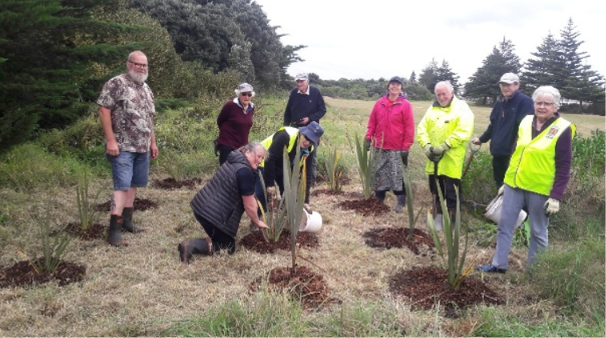
In September 2023 the plants were ready to be planted, and Paul of Coast Care had cleared an area for their specific planting. A group from Castelecliff Coast Care, Te Awa Whiri Toi and Quaker Acres came to plant them.
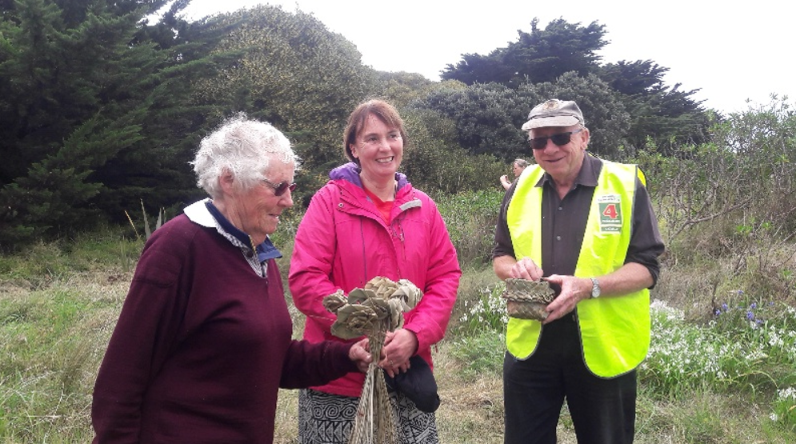
After the planting a few words were said as we stood in a circle and the Te Awa Toi gifted some of their weaving to the Coast Care and Quakers.
After Sea Week in March 1925 Castlecliff Coast Care realised they needed some tutoring in caring for all the harekeke and wharariki they had organised the planting of along the backdunes by Seafront Road and the playarea.
They called on Te Awa Whiri Toi for guidance on Tikanga. Margot from Te Awa Whirir Toi came out in January.
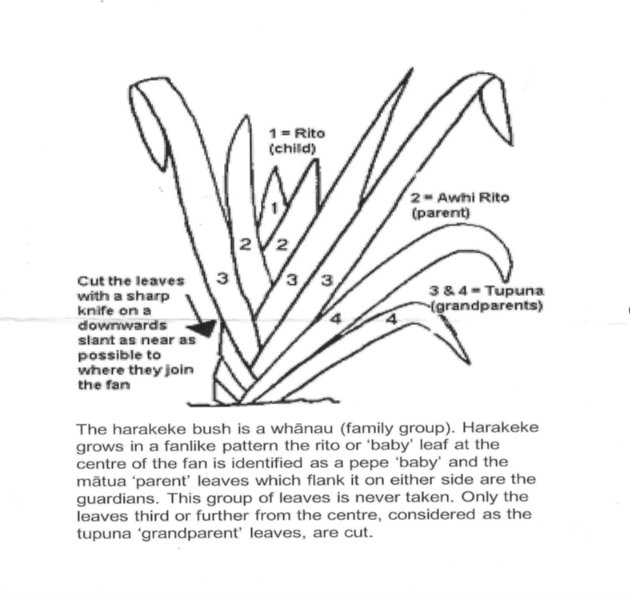
She introduced us to a karakia, talked about how the how the harekeke grows in fans each representing a generation of growth. Telling us when there is more than one fan treat each similarly.
She introduced us to Tikanga associated with weaving and harekeke use.
Telling us to only cut harakeke in fine weather and away from the centre on a slope to encourage rain to run off. Be careful of sharp knifes. If unwell, under influence of drugs, etc, pregnant or having your period don’t cut harekeke. Start with a karakia. Don’t stand upon harekeke or weaving. Don’t smoke, eat or drink while working with harekeke.
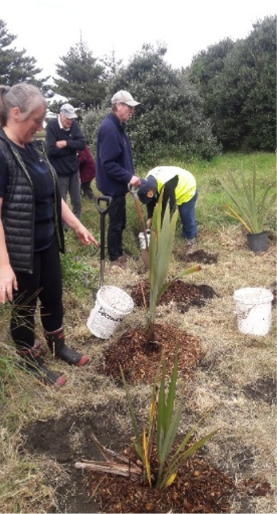
Telling us to only cut harakeke in fine weather and away from the centre on a slope to encourage rain to run off. Be careful of sharp knifes. If unwell, under influence of drugs, etc, pregnant or having your period don’t cut harekeke. Start with a karakia. Don’t stand upon harekeke or weaving. Don’t smoke, eat or drink while working with harekeke.
Glossary
Urewera – area around Lake Waikaremoana, between Wairoa & Whakatane
Whᾱriki – woven mat
Whanu – warp, lengthwise thread on a loom
Ngᾱti Porou – Iwi of Tai Rᾱwhiti (East Coast)
Kete – basket. Usually woven out of harekeke
Aho – weft, crosswise thread going across loom. (Usually shorter and possibly not as strong as the warp.)
Tᾱiki pēpe – a baby’s cradle, usually woven.
Muka kete – flax fibre
Kᾱkahu – clothing
Kiekie – a climbing plant sometime used in weaving Te Awa Whiri Toi is a group that learnt to weave together at Te Wananga o Aotearoa and have a studio in Gonville during Open Studio time.